
Beginner Strength Training: A Safe, Simple Guide for Adults

Strength training can start with simple movements and little or no equipment.
If you are new to exercise, beginner strength training does not have to mean lifting heavy weights or joining a gym. Many adults can start with body-weight movements, a sturdy chair, a wall, or light resistance bands. The most useful first step is choosing movements you can perform comfortably and learning them at an easy pace.
The Centers for Disease Control and Prevention (CDC) recommends that adults include muscle-strengthening activity on at least two days each week, working the major muscle groups. 1. That is a general public-health guideline—not a personalized prescription. Your starting point should reflect your ability, health, and experience.
What counts as strength training?
Strength or resistance training asks your muscles to work against resistance. That resistance can come from your body weight, a resistance band, a light household object, or gym equipment. Examples include standing up from a chair, wall push-ups, carrying groceries, and using light weights. 2
A beginner routine can focus on movements that use several areas of the body: legs and hips, chest and arms, back, shoulders, and abdomen. You do not need a complicated exercise split or a long daily workout to begin practicing these movement patterns.
Benefits of starting gradually
Regular strength activity can help build or maintain muscle strength and make everyday movements—such as standing from a chair or carrying shopping—easier. The National Institute on Aging describes muscle-strengthening activity as one part of a varied exercise routine, alongside aerobic and balance activities. 2
Progress takes time. One workout will not transform fitness, and there is no need to compare your routine with someone else’s. Aim to practice consistently, use controlled movements, and make gradual changes when your current routine starts to feel manageable.
A simple beginner routine at home
The following movements are examples, not a requirement to do every exercise. Choose the ones that feel comfortable for you. Use a stable chair that does not have wheels, clear enough space to move, and keep a wall or support nearby when balance is a concern. The UK National Health Service (NHS) provides similar chair-based and wall exercises for adults who want a gentle place to start. 3
1. Sit-to-stand
Sit toward the front of a sturdy chair with your feet on the floor. Lean forward slightly and stand up slowly, using your legs. Sit back down with control. If you need your hands for support, use them. The NHS suggests beginning with a small number of repetitions and building up gradually. 3
2. Wall push-up
Stand facing a wall at a comfortable arm’s length. Place your hands on the wall around chest height. Keeping your body in a comfortable straight line, bend your elbows to bring your chest closer to the wall, then press gently back to the starting position. Move only through a range that feels comfortable.
3. Supported calf raise
Stand behind a stable chair and hold it lightly for balance. Slowly raise your heels, pause briefly if comfortable, and lower them with control. Do not pull hard on the chair or lean your whole body forward.
4. Standing side leg raise
Hold the back of a stable chair. Keeping your body upright, move one leg a short distance out to the side, then return it slowly. Repeat on the other side. Use a smaller range or skip this movement if it causes discomfort or affects your balance.
5. Light biceps curl
Sit or stand comfortably and hold a very light weight, such as a small filled water bottle, only if you can do so safely. Keep your elbows near your sides, bend them to bring your hands upward, and lower slowly. You can begin without weights while you learn the motion.
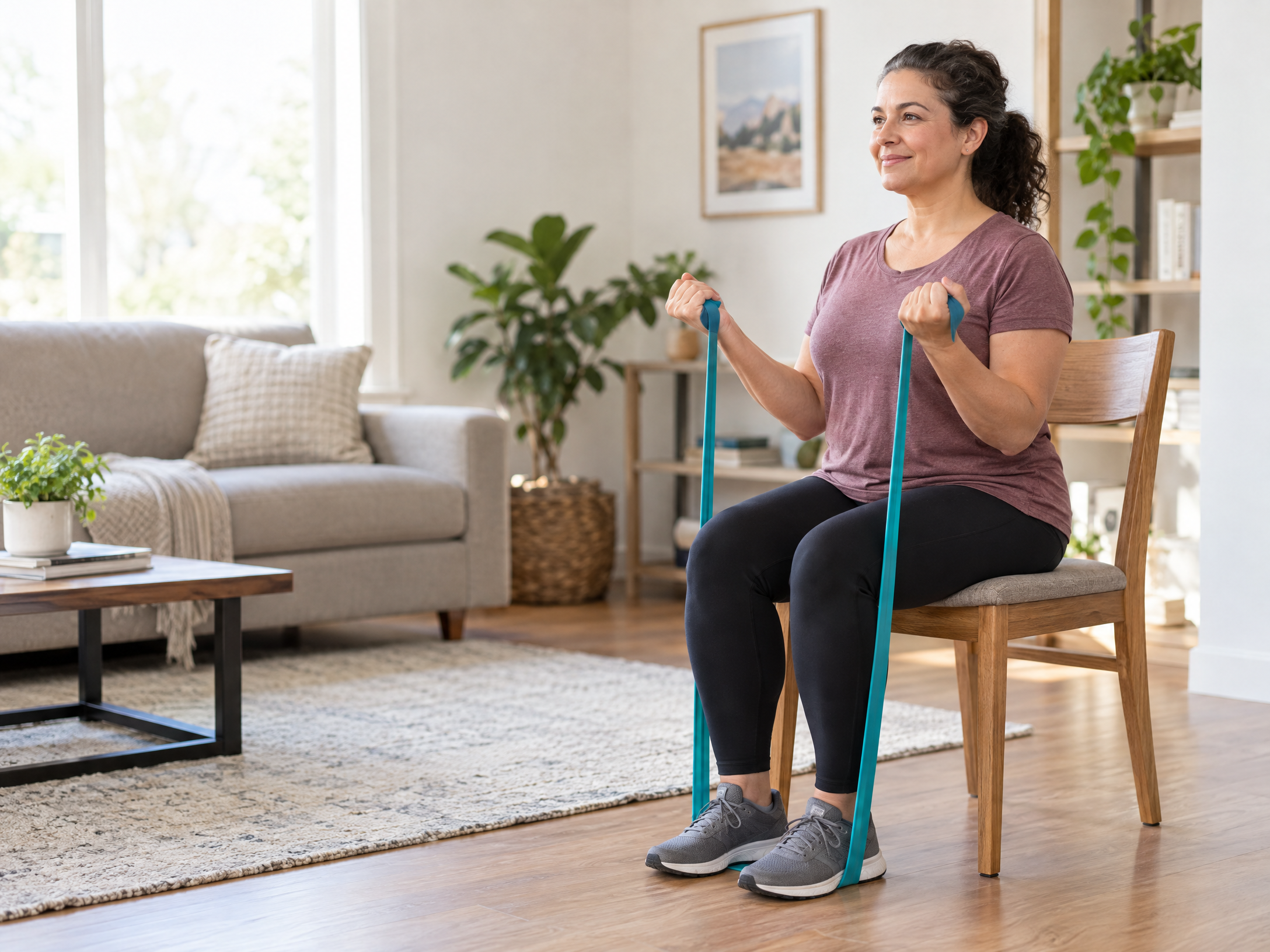
Light resistance or body-weight exercises can be adjusted to match a beginner’s current ability.
How much should you do?
For your first sessions, keep the routine easy enough that you can focus on control and breathing. The NHS examples start some chair exercises with five repetitions and recommend gradually increasing repetitions over time. 3 You can rest between movements. If a movement feels too difficult, use a supported or smaller-range version—or leave it out and ask a qualified professional for an alternative.
There is no need to train the same muscle groups hard every day. The National Institute on Aging advises allowing recovery between sessions that work the same muscle groups. 2. A simple schedule might place strength sessions on two nonconsecutive days, such as Tuesday and Friday, with rest or comfortable light activity in between.
A realistic weekly activity plan
The CDC’s adult guidance combines muscle-strengthening activity with aerobic movement. It recommends at least 150 minutes of moderate-intensity aerobic activity each week, along with strength work on two days. The aerobic minutes can be divided into shorter sessions, and some activity is better than none. 14
If you are building a routine from scratch, start with a level you can manage. For example, choose two short strength sessions and add comfortable walks on other days. Over time, you can gradually increase the time, repetitions, or resistance—but change one thing at a time and keep your form comfortable.
Safety tips for new exercisers
•Start with an easy version. Use body weight, a wall, or a stable chair before adding resistance.
•Move slowly and with control. Avoid swinging, bouncing, or rushing through repetitions.
•Keep breathing. Do not hold your breath; breathe naturally throughout each movement. 2
•Use a safe setup. Check that chairs are stable, the floor is clear, and footwear is suitable for the activity. 3
•Stop if something feels wrong. Stop exercising if you develop chest pain or pressure, dizziness, or unusual severe shortness of breath, and seek appropriate medical help.
•Ask for tailored advice when needed. If you have a chronic health condition, an injury, balance problems, or a disability, talk with a healthcare professional about what activity is right for you. The CDC recommends discussing activity with a doctor when you have a chronic health condition. 4
Muscle effort can feel challenging, but sharp pain is not a goal. Do not push through new or worsening pain. A doctor, physical therapist, or qualified exercise professional can help you choose safe modifications.
How to make progress without rushing
Once you can complete a movement comfortably and with control, you may gradually add a few repetitions or use slightly more resistance. You can also improve consistency by choosing a regular time and keeping simple equipment where you can find it. The National Institute on Aging notes that strength can improve with gradual increases in weight, repetitions, sets, or training days. 2
Keep a brief note of the exercises you practiced and how they felt. If you miss a session, resume when you can rather than trying to make up for it with an exhausting workout. A routine you can repeat is more useful than a plan that is too demanding to maintain.
Frequently asked questions
Can I build strength without going to a gym?
How many days a week should beginners do strength training?
For general adult health, the CDC recommends muscle-strengthening activities on at least two days per week, working the major muscle groups. 1 Beginners can start with manageable sessions and adjust based on ability, recovery, and any medical advice they have received.
Do I need to feel sore after a workout?
No. Soreness is not a requirement for progress. Focus on using controlled movements and building a routine you can repeat. If pain is sharp, severe, or persistent, stop and seek appropriate advice.
Should strength training replace walking or other cardio?
Not necessarily. Strength work and aerobic activity serve different roles in general activity guidance. The CDC recommends including both muscle-strengthening activity and aerobic movement in an adult’s weekly routine. 1
The takeaway
A beginner strength routine can be simple: learn a few comfortable movements, use a safe setup, and practice on a regular schedule. Start with little or no equipment, progress gradually, and ask for individualized advice if you have health or mobility concerns. The goal is to build a sustainable habit—not to rush through a demanding workout.
This article is for general education and is not a diagnosis or individualized exercise prescription.
Sources and further reading
Publishing SEO notes
•SEO title: Beginner Strength Training: A Safe Home Workout Guide
•Meta description: New to strength training? Learn how to start with simple home exercises, build a beginner routine, use good form, and progress safely over time.
•Canonical URL: Use the final published URL for this new article; do not canonicalize it to an unrelated page.
•Featured image: images/beginner-strength-hero.png
•Featured image alt: An adult beginner practicing a controlled sit-to-stand exercise from a sturdy chair at home.
•Inline image alt: An adult beginner using a light resistance band while seated upright on a stable chair at home.
•Internal links to add: Link naturally to the site’s medical disclaimer and one or two closely related, updated fitness articles. Avoid unrelated categories.
•Structured data: Use the CMS’s Article schema if available. Set the actual publication and update dates and the real author. Add a medical reviewer only after a qualified professional has reviewed the final article.
•Editorial check before publishing: Verify all source links, confirm the byline and any review credentials, and check that every exercise illustration reflects the written instructions. No article can guarantee AdSense approval.